Building a Mountain Region Where Everyone Can Thrive
Just Economics
Western North Carolina has always been shaped by people who know how to build a life in the mountains — crafting local businesses, taking care of neighbors and adapting to change together.
Today, communities across the region are working to make sure people can continue to live and work here, even as housing costs rise and seasonal tourism shifts the economy.
Just Economics is one of the organizations helping advance that future.
Based in Asheville and working across surrounding counties, Just Economics educates, advocates and organizes around policies conducive to a just, equitable and sustainable economy for Western North Carolina: reliable public transit, living wages and affordable housing.
“A just economy, for me, means everyone has what they need and is valued for what they’re contributing to this community,” says Executive Director Vicki Meath. “All types of work, both paid and unpaid, should be recognized and valued so people can live a decent quality of life.”
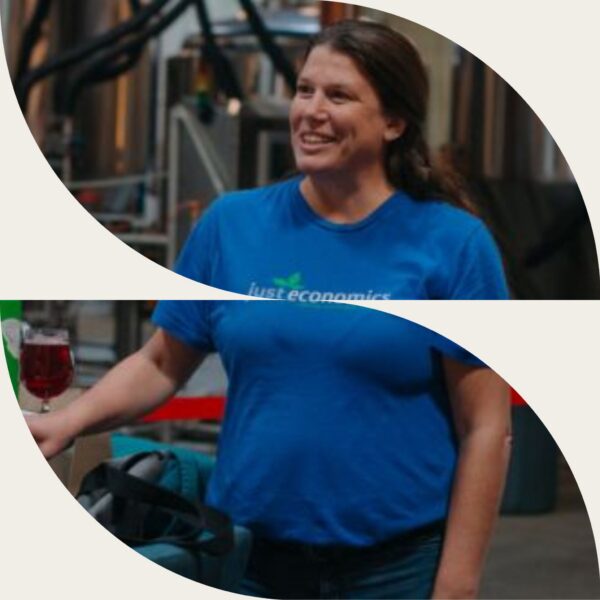
“A just economy means everyone has what they need and is valued for what they’re contributing.”
– Vicki Meath, Just Economics
Local Expertise, Regional Advocacy
Policies crafted hundreds of miles away make that vision challenging to pursue. North Carolina frequently tops the list of “best states for business” yet falls at the bottom of lists measuring workers’ rights and wages. The statewide minimum wage remains $7.25 — the floor set by the federal government in 2009 — and local governments are prevented from setting their own.
But people in Western North Carolina aren’t waiting for Raleigh to solve these challenges.
Communities are organizing, employers are stepping up, and families are advocating for policies that reflect the needs of people who make this region what it is.
“Unfortunately, the ranking that’s best for business actually rewards states for their anti-labor laws,” says Sam Stites, Just Economics’ Living Wage Program Coordinator. “The more anti-labor you are, the better you’ll do in that ranking. That’s not how we would measure a strong business economy. That’s not how these employers would measure a strong economy, but it’s powerful in our politics.”
Win-Win-Win
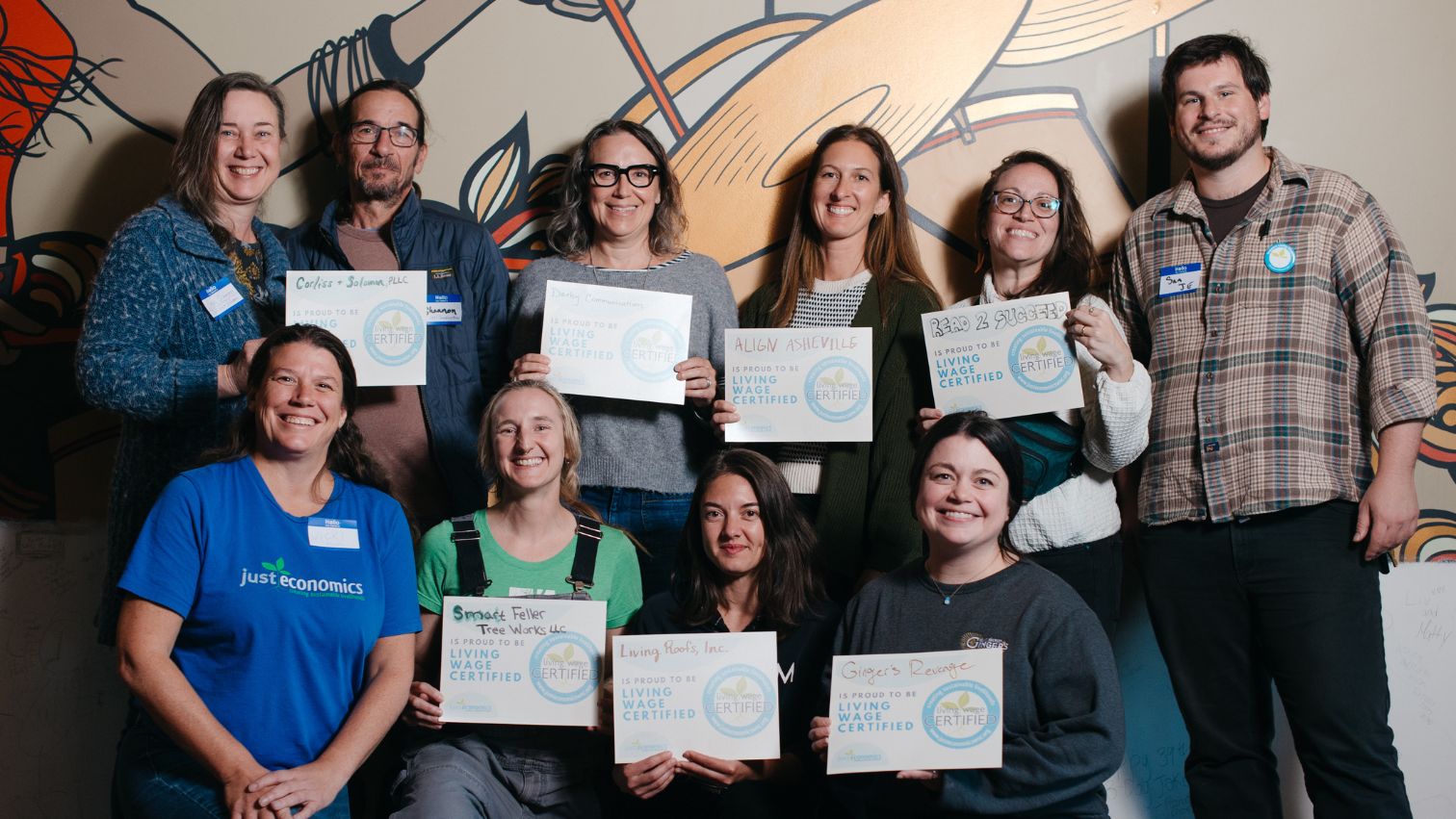
Sam gestures to a group of people chatting with each other as he drops markers and papers on tables in an Asheville brewery. They are all living wage certified employers, meaning they commit to paying workers wages that reflect local cost of living — a rate Just Economics calculates each year.
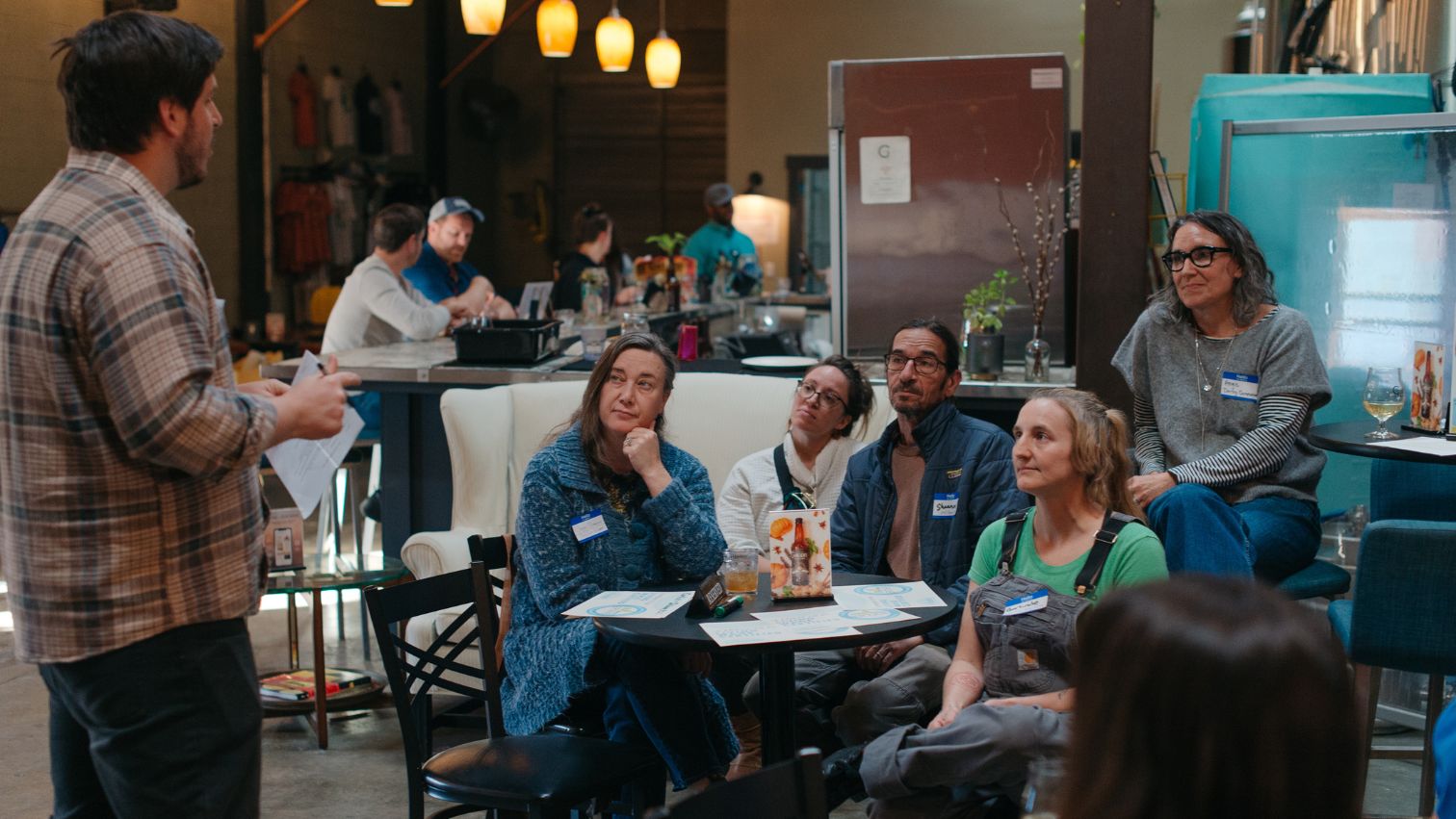
The employers — from tree service companies to nonprofits to green construction — say that paying a living wage helps them stay rooted here.
“We have longevity, which is rare in the service industry,” says Tammy Clayton of local brewery Ginger’s Revenge. She says the policy helps with hiring, retention and service. “When we say we’re living wage certified, you can see people relax and take a breath, like, ‘This is a company that’s gonna take care of us.’”
The benefits to workers are clear: Living wages lift families out of poverty and allow people to maintain a decent quality of life even as costs rise.
“Working in arboriculture is a very physical job,” says Gerlinde Gentzke, a Certified Arborist for Smart Fellers TreeWorks. “Making sure people are making enough money to go to the acupuncturist, get massages, go to physical therapy — all of those things are huge for our employees. When people get paid living wages, they can take better care of their families, everyone’s mental health is better, their wellbeing is better, and that helps our company thrive.”
“When people get paid living wages, their well-being is better, and that helps our company thrive.”
– Gerlinde Gentzke, Smart Fellers TreeWorks
The certification also benefits employers, who enjoy higher staff morale, health and performance. Living wage lowers absenteeism, turnover, and recruiting and training costs. Employers have found consumers are willing to pay more for living wage certified goods and services.
“I’m really proud we have the [living wage certification] logo on our site,” Gerlinde says. “It is one of my proudest talking points when I go to our national and international meetings and share this really cool thing Western North Carolina is doing. It’s really important that employers use their power and position to structure their companies to take care of their workers. We can’t leave it to any administration to delegate.”
The benefits ripple out into the community. Living wages boost the state and local economy as working people rely less on social services like food assistance. They also stimulate consumer spending.
“We’re seeing this movement not just in the cities or the places people might expect, but far out into the 20 Western North Carolina counties where we have certified employers because cost of living is accelerating across the board,” Sam says. “A lot of people want to shop with their values, to know they’re funding the local economy. It’s the consumer preference, it’s the employee retention and getting to say that you’re part of this movement.”
Public transit shaped by the people who ride it
On a blustery day in downtown Asheville, Mike Holmes chases donut boxes skittering across the bustling bus depot. He recognizes a bearded passenger and greets him: “Hey, Santa. You want a donut? We got one more.”
Mike and his colleague Seimy Mendoza are community organizers who know that the people who rely on public transit understand it best. They’re offering riders donuts and coffee and encouraging them to fill out the city’s survey about the future of public transit.
“We’re making sure people most affected by these decisions are at the center of them,” Mike explains, as he hands out flyers printed in English, Spanish and Russian.
When language barriers kept some riders out of the conversation, organizers worked with community members to create accessible Spanish and Russian translations, ensuring local riders knew what was happening and how to weigh in.
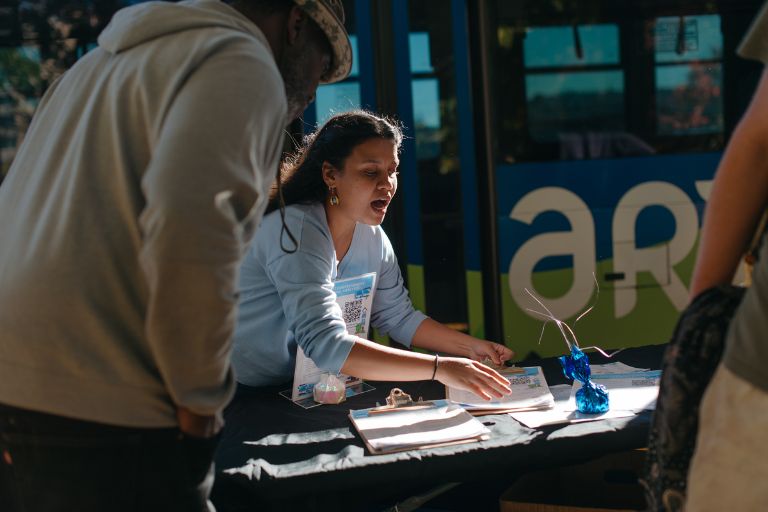
Community Organizer Seimy Mendoza directs a bus rider to information about Asheville’s transit survey. Photo by Jesse Barber
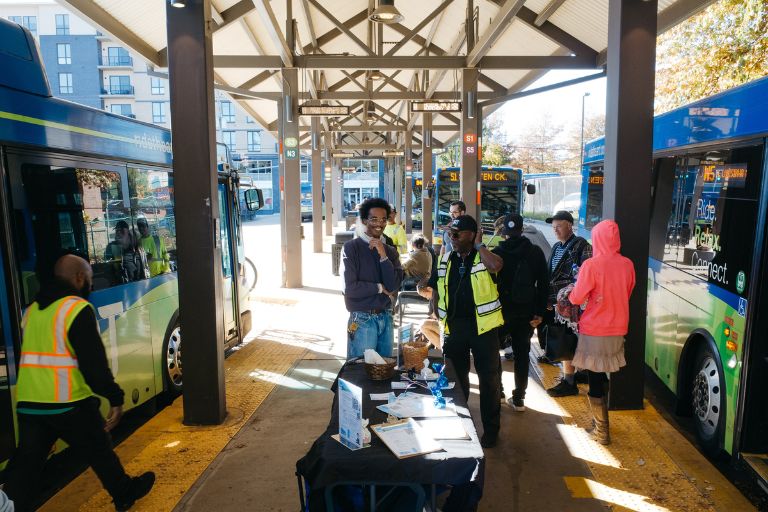
Community Organizer Mike Holmes speaks with a bus driver at the Asheville transit station. Photo by Jesse Barber
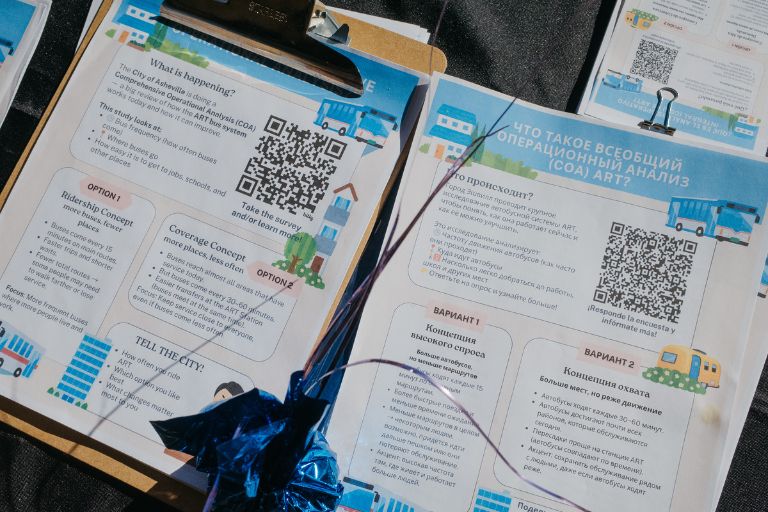
Just Economics partnered with community members to provide survey information in English, Spanish and Russian. Photo by Jesse Barber
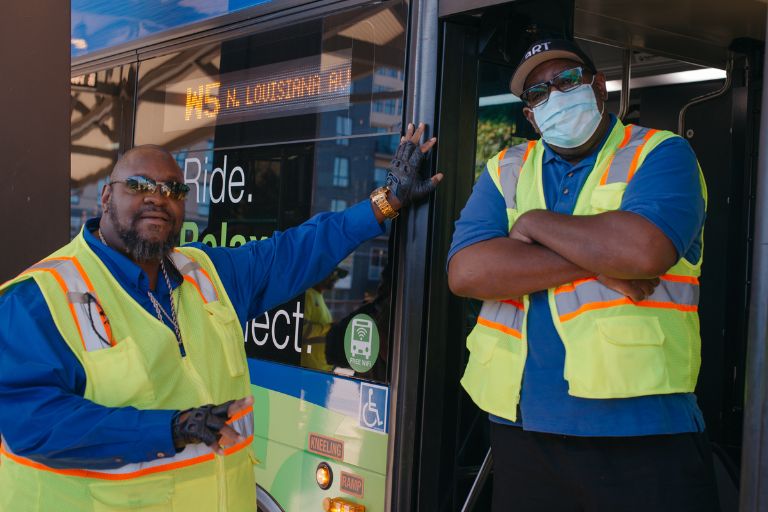
Asheville bus drivers wait for riders at the depot. Photo by Jesse Barber
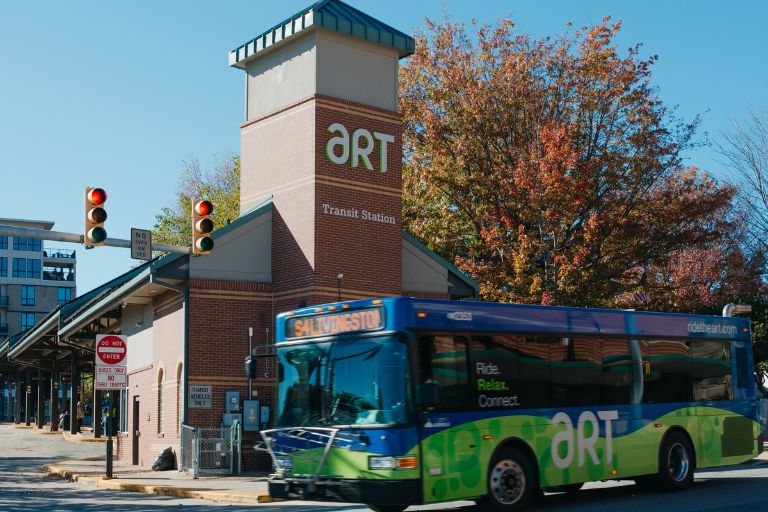
Buses come and go from the busy Asheville Regional Transit center. Photo by Jesse Barber
For both Mike and Seimy, reliable public transit is a deeply personal issue.
“I’m a product of the displacement,” Mike explains. “My family grew up in Shiloh, which is one of the historic Black neighborhoods. I don’t get to live in the community my parents grew up in because it got too expensive, even for them. This town continues to cater to tourists and hotel developers. So a lot of people, from my generation to the generation before me, have not been able to see this as a feasible place to raise a family, to find work that sustains them.”
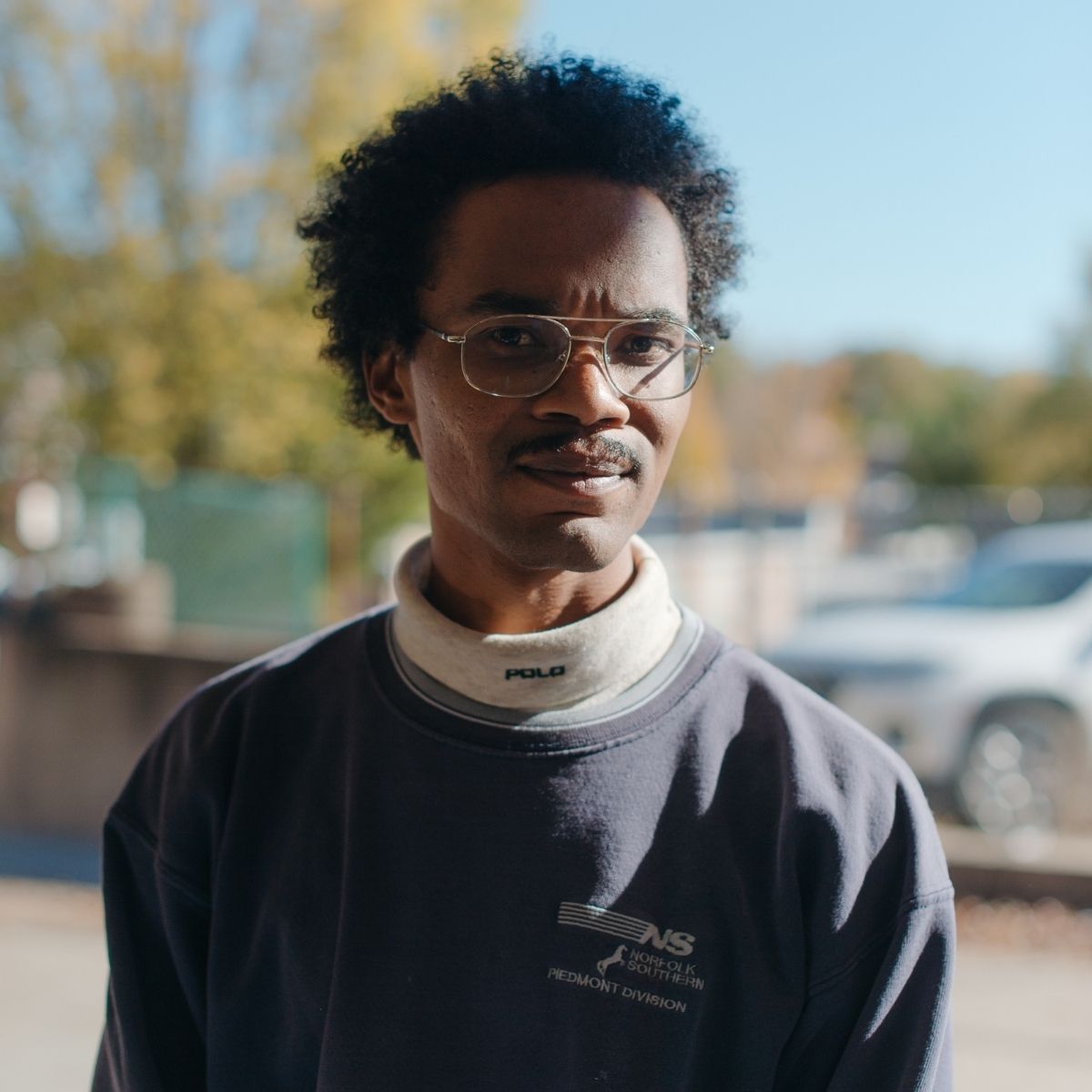
Seimy walked a very different road to arrive at the same conclusion.
“I was born in Honduras where transit is not great, but it’s accessible and available all the time,” she shares. “When I moved to Swannanoa, I asked someone, ‘Where can I get the bus to go to the supermarket?’ And they replied, ‘Oh the bus doesn’t run here.’ I said, ‘Huh? So how do people get around?’ And they’re like, ‘You need to have a car.’ ‘But I can’t afford a car.’ And I’m not the only person in that position. As a city, we should be thinking, if people are struggling to get a car, how are we building systems that allow people to move back and forth to their jobs, to be connected to their community, to their families?”
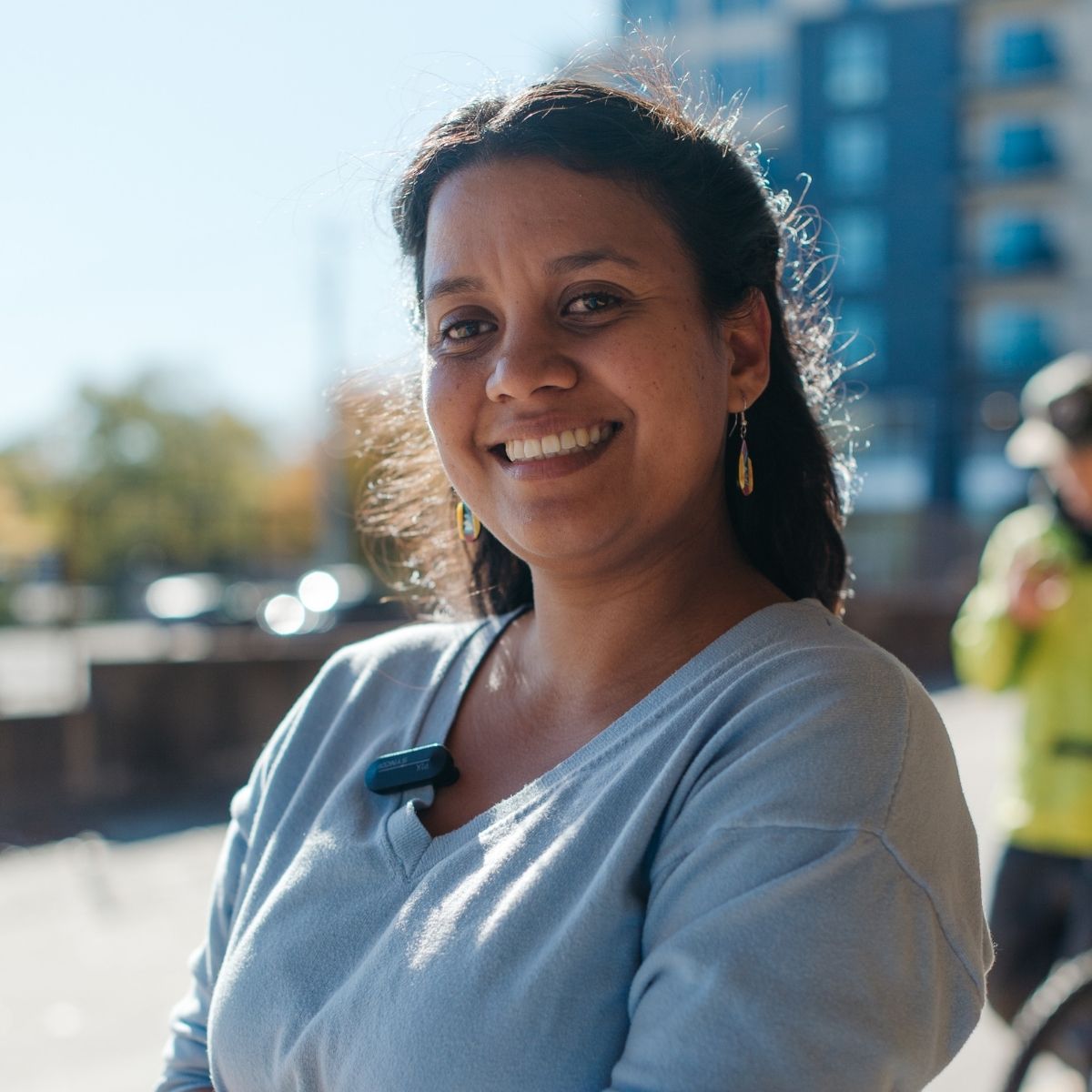
For Vicki, it’s important to celebrate every win the community achieves. After organizing for a 19-point agenda for transit reform, the first win was Sunday bus service — something riders had been asking for for years.
“When the bus went by church services on Sundays, people who helped organize would say, ‘We did that!’” Vicki remembers. “It’s important to celebrate wins, especially ones led directly by the people most impacted.”
“Finding Your Tribe:” Voices for Economic Justice
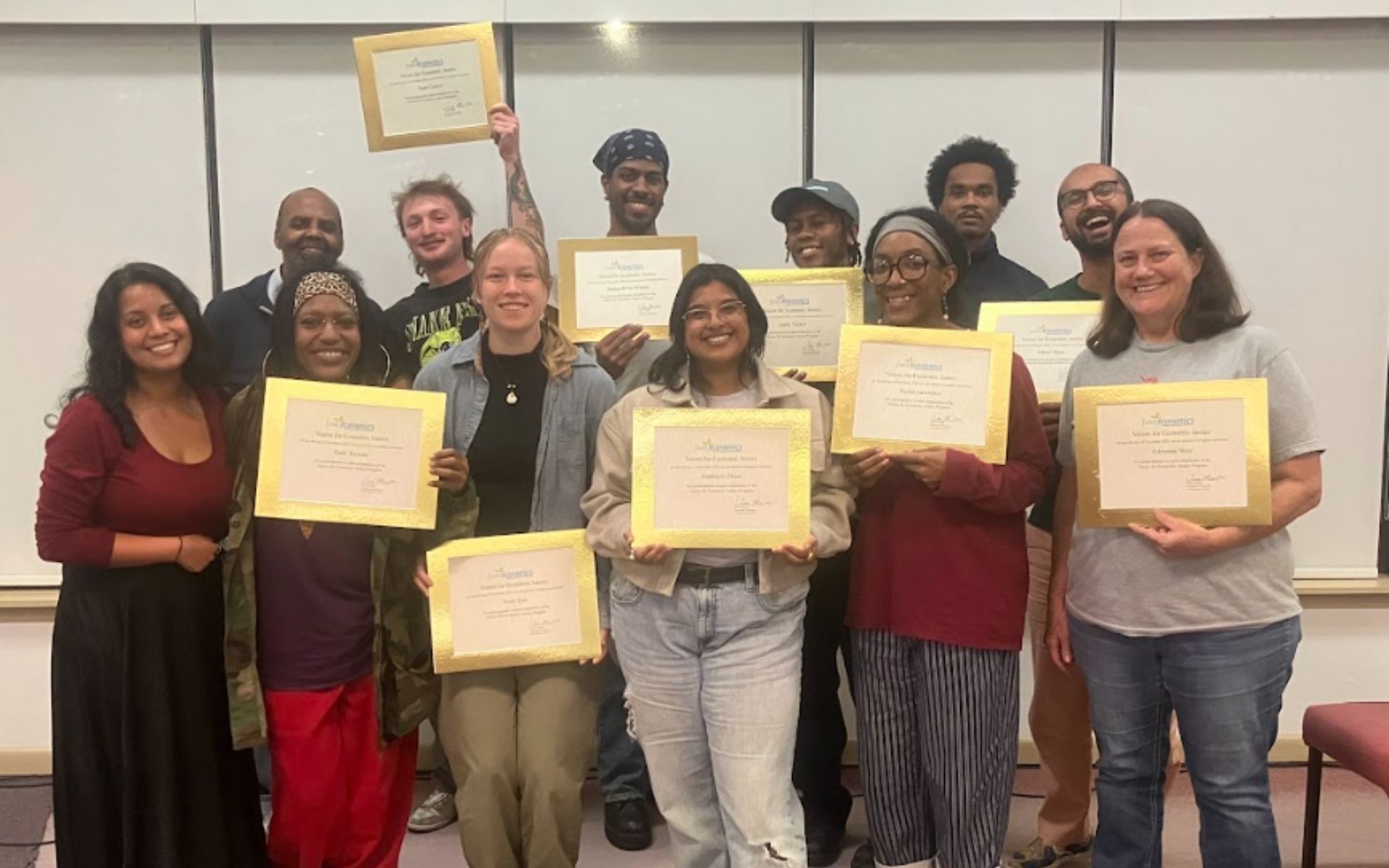
Just Economics also builds community leadership through Voices for Economic Justice, an eight-week workshop that offers an introduction to economic justice, the labor movement, advocacy and grassroots organizing.
Participants include low-wage workers, students and community members who want to understand policy and build networks to create change.
Gennie Gonzalez is an alumna of the program. Gennie, who is the daughter of immigrants and has firsthand experience with economic hardship, was attracted to Just Economics’ focus on creating an equitable economy that centers the needs of working people.
“It was 2020. I had just graduated from college into a poor job market, the isolation of COVID and the aftermath of George Floyd’s murder. I felt like in the spaces that I was in, we weren’t really talking about inequalities along lines of race and class and how they’re interconnected. Then I found Just Economics. It was refreshing to be in a space to talk about social issues and how to address them in our community. It’s like finding your tribe.”
Gennie now serves as a property manager for cooperative housing and uses the financial and organizing skills she learned through the program in her day-to-day work.
Not only did Gennie graduate from the program, she also has served on Just Economics’ board of directors — an example of the organization’s commitment to reflecting the diversity of the community and listening deeply to the people most proximate to its issue areas.
A people-powered future
All of these people come to Just Economics from unique backgrounds — displacement, immigration, wealth inequality. They also share common challenges — a pandemic, a devastating hurricane, sociopolitical unrest.
But within these challenges lie opportunities for Western North Carolina. With the support of Just Economics, people are organizing, teaching and advocating for an economy that works for everyone. Workers, employers and community leaders are designing solutions grounded in dignity, local knowledge and a shared commitment to place.
The future of the region isn’t something happening to Western North Carolina’s communities — it’s being built by them.
More News + Stories
ZSR Awards $9.4 Million to Organizations Working for Systemic Change in NC
The grants support nonprofit organizations working to change policies, power structures and other root causes of challenges so that all North Carolinians can lead fulfilling lives.
Read MoreZSR Announces $19.2 Million in Funding to Organizations Working for Systemic Change in NC
The grants support nonprofit organizations working to change policies, power structures and other root causes of challenges so that all North Carolinians can lead fulfilling lives.
Read MoreNorth Carolina Local News Lab Fund announces Press Forward Charlotte
This week, the North Carolina Local News Lab Fund announced the launch of Press Forward Charlotte, a new local chapter of Press Forward North Carolina. Press Forward Charlotte is a platform to fuel investment in Charlotte’s news and information ecosystem and spur collaboration among local funders. The launch comes as several local Charlotte funders make new…
Read More English
  Español